
Dissect a frog with no specimens, no smell and no ethical worries. In this free virtual frog dissection, students look at the outside of a frog, open the body with scissors, and move the organs aside with forceps to find what is hidden underneath. They explore the frog’s digestive, respiratory, circulatory, excretory, nervous and reproductive systems, compare them with their own body, and finish with photos of real frog dissections.
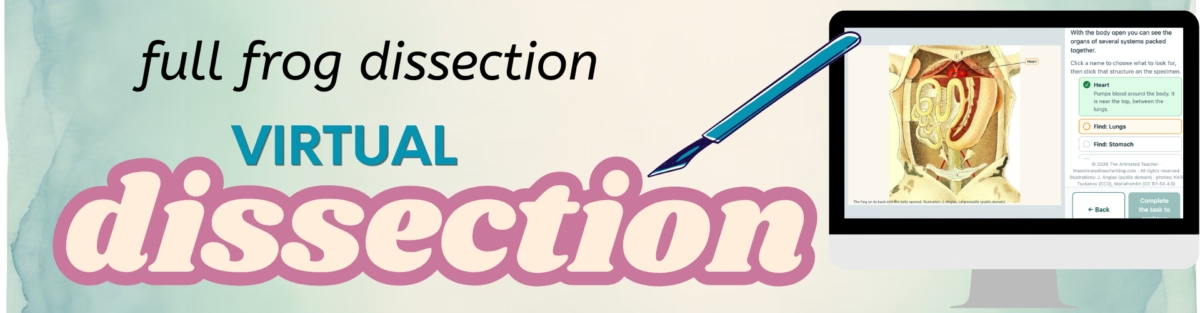
What students do in this virtual frog dissection lab
- identify the outside features of a frog and explain how they suit life on land and in water
- cut open the body and find the heart, lungs, stomach, intestines, bladder and cloaca
- trace the path of food through the digestive system
- fold the intestines aside and lift the liver to find the gall bladder, kidneys, fat bodies and reproductive organs
- compare male and female frogs and find the same organs on photos of real frogs
- explore the circulatory, nervous and skeletal systems and sort organs into their systems
Syllabus links
This lab supports the NSW Science Stage 4 outcomes on cells, tissues, organs and organ systems, and on comparing the structures of different organisms. It also suits middle school units on body systems, amphibians and animal adaptations.
Get the printable worksheet to accompany the virtual frog dissection lab
The matching worksheet takes students through the lab question by question, with large label boxes for the diagrams and a full answer key, in colour and black and white. Get the Frog Dissection Virtual Lab Worksheet on TpT: [TpT link – Lab 6]
Frequently asked questions
Is a virtual frog dissection as good as a real one? Students find the same organs and practise the same steps, with no specimens to buy or dispose of. Many schools now use a virtual frog dissection instead of a real one, or for students who choose not to take part.
How is a frog’s body different from ours? A frog has a three-chambered heart instead of four chambers, can breathe through its moist skin as well as its lungs, and has a single opening called a cloaca for wastes and eggs or sperm. Students compare these in the lab.
More free virtual dissections
Try the digestive system dissection, heart dissection, lung dissection, kidney dissection, sheep brain dissection or frog dissection, or see all the virtual dissections here.